One of the most useful things a prospective homeowner can understand before starting a custom build is which decisions move the budget up and by how much. Not every upgrade costs the same. Some choices that seem minor on paper have significant cost implications. Others that feel like major splurges are actually quite reasonable relative to the project total.
In Central Nebraska, where custom homes typically range from the mid-$300s to well over $700,000 depending on size, finish level, and configuration, knowing where the dollars go gives you real leverage over the outcome. You can make informed tradeoffs rather than discovering surprises after the contract is signed.
This article covers the major cost drivers in a custom home build, roughly in order of impact.
Square Footage Is the Biggest Lever
Everything else being equal, a larger home costs more to build. That is obvious. What is less obvious is how directly and consistently cost tracks with square footage in a custom home. Most of the systems in a house — framing, insulation, HVAC, electrical, plumbing, roofing, and drywall — scale closely with the size of the structure.
Right-sizing the footprint is one of the most effective ways to control budget. Many families who start the design process with an instinct toward more square footage find, after working through the layout, that a well-designed smaller home serves them better than a larger one that stretches the budget uncomfortably.
Roof Complexity
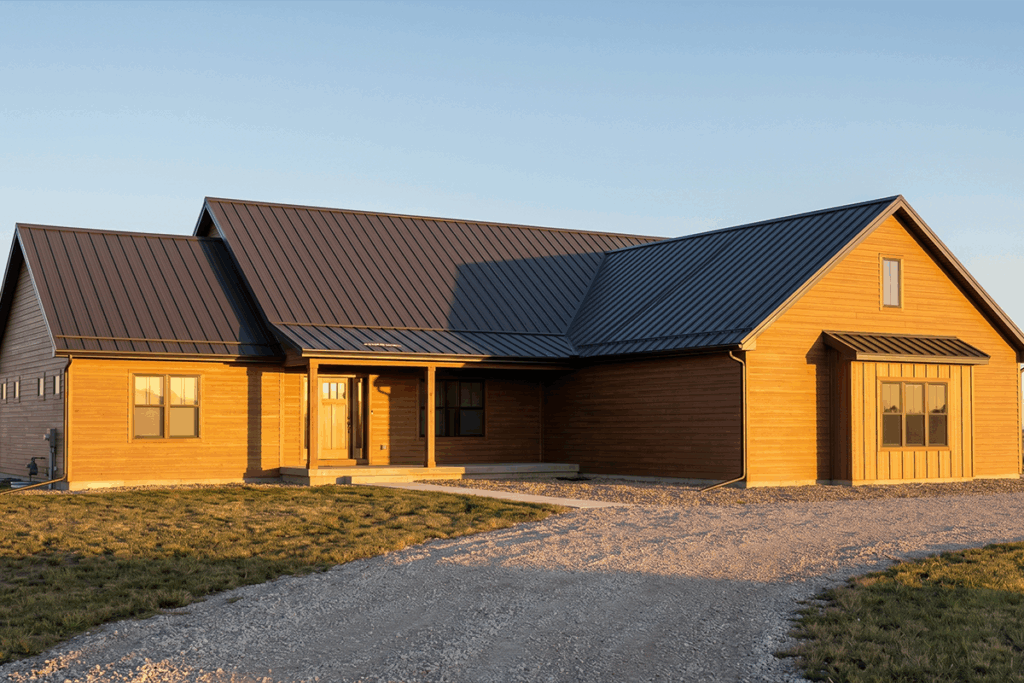
Rooflines are one of the most underappreciated cost drivers in residential construction. A simple gable or shed roof with clean lines and minimal valleys is significantly less expensive to build than a complex hip roof with multiple intersecting planes, dormers, and valleys.
Roof complexity affects framing labor, the quantity and waste factor of roofing material, flashing requirements, and the amount of time the crew spends on the most dangerous and time-intensive part of the structure. A highly complex roofline on a moderately sized home can add tens of thousands of dollars compared to a simpler alternative.
This does not mean complex rooflines are never worth it. A well-designed roofline is a significant part of a home’s curb appeal and architectural character. But if budget is a constraint, simplifying the roof is one of the higher-leverage concessions available during design.
Foundation Type
The foundation you choose has a material impact on cost. A full basement adds significant expense — both in excavation and in the concrete work itself — but it also adds finished or unfinished square footage that can be comparable per square foot to that of an above-grade space.
A walkout basement, which requires specific site topography and more complex framing at the transition between the basement level and the main floor, costs more than a standard full basement. A slab foundation is the least expensive option and is common in shouse and barndominium builds, though it changes how mechanical systems are routed and eliminates the storage and utility space that a basement provides.
In Central Nebraska, full basements are common for good reason — they provide storm shelter, storage, and the potential for additional living space at a cost-per-square-foot that is lower than the main floor. Whether a basement makes sense for your project depends on your site, your soil conditions, and what you intend to do with the space.
Kitchen and Bathroom Specifications
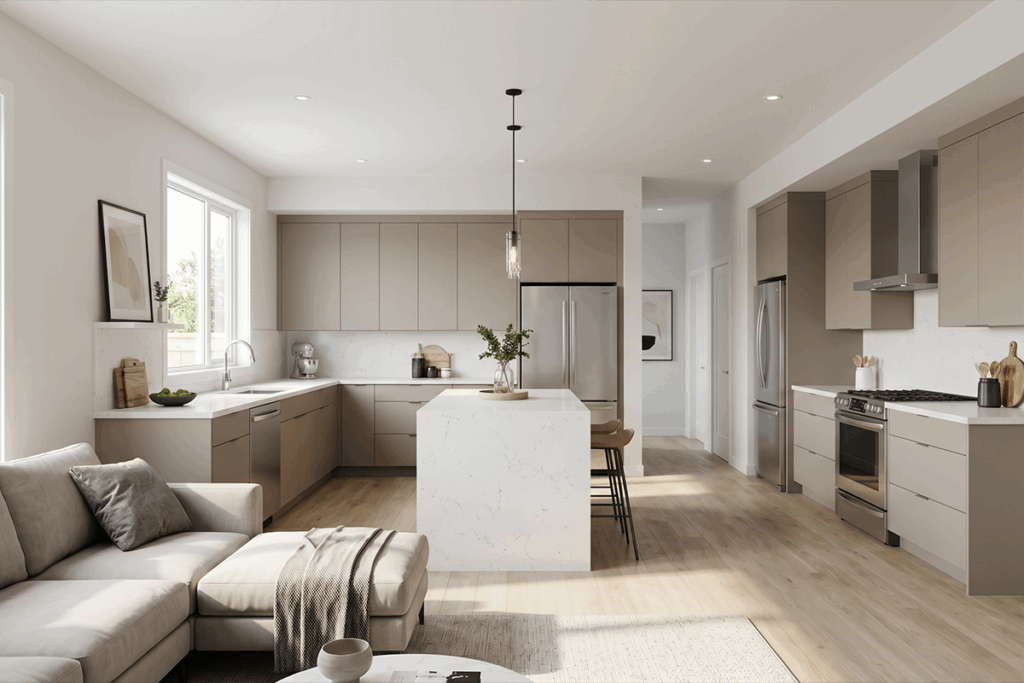
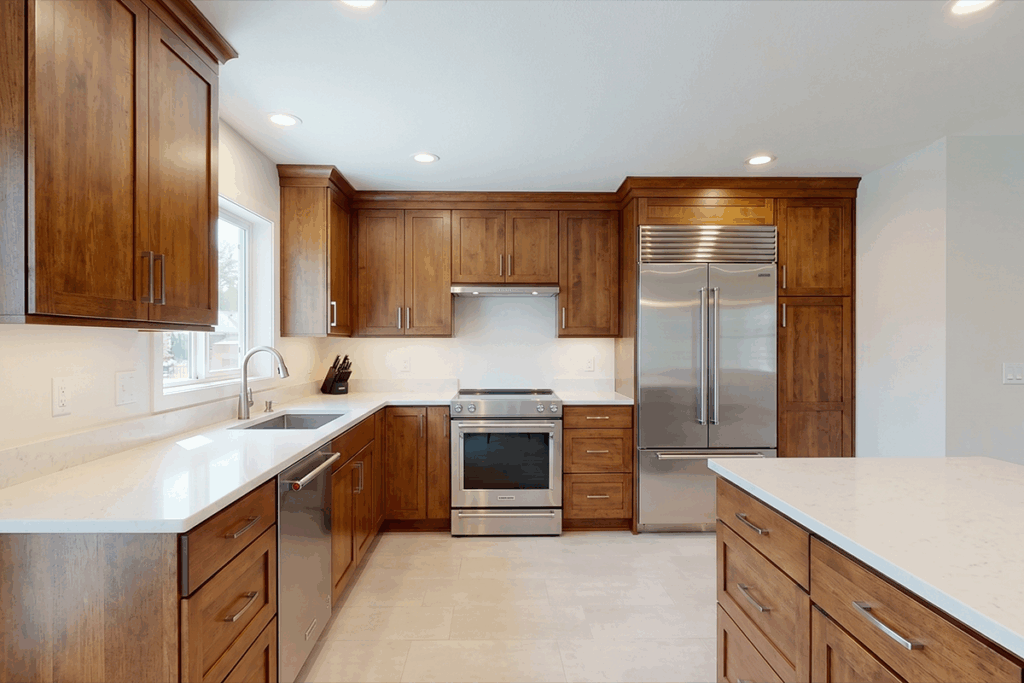
Kitchens and bathrooms are where finish-level decisions have the largest impact on total project cost. These are the rooms with the highest concentration of expensive materials and skilled labor: cabinetry, countertops, tile, plumbing fixtures, and appliances in the kitchen; tile, glass, plumbing, and fixture packages in the bathrooms.
Cabinet selection alone can swing a kitchen budget by $20,000 to $40,000 or more depending on whether you are choosing stock, semi-custom, or full custom cabinetry. Countertop material choices — between laminate, quartz, granite, and custom stone — span a similar range. Appliance packages can range from the mid-single thousands to well over $20,000 for a full professional kitchen setup.
Bathrooms follow similar logic. A primary suite bathroom with a tile shower, soaking tub, dual vanity, and quality fixtures is a meaningfully different budget line than a secondary bathroom with a standard tub-shower combination. Products like the Onyx Collection, which offers custom-fitted shower panels and bases without the grout maintenance of tile, fall in the mid-range and deliver a high-end appearance at a more predictable installed cost.
Insulation System
Insulation is a cost driver that homeowners often underestimate, partly because it is invisible once the walls are closed and partly because the range of options is not always well understood.
Fiberglass batt insulation is the baseline. It is the least expensive to install and provides adequate performance in a conventionally framed wall if installed correctly. Spray foam insulation — either open-cell or closed-cell — costs significantly more but delivers better air sealing, higher R-values per inch, and long-term energy performance that reduces heating and cooling costs over the life of the home.
For metal building homes and shouses, spray foam is truly the best option. Metal conducts temperature aggressively and provides no inherent thermal resistance. A metal building insulated with fiberglass batts will be uncomfortable and expensive to heat and cool. Closed-cell spray foam should not be applied directly to the interior of the metal panels however as this can lead to long term warranty and corrosion issues, better practice would be to have a barrier material receive the foam application. With proper planning and a well executed install, spray foam is a great system, and it is one of the higher line items in a metal building home budget.
Garage and Shop Square Footage
Attached garage and shop space typically costs less per square foot to build than finished living space because the finish requirements are lower. There is no drywall, flooring, trim, or interior fixtures to account for. But it still costs real money — concrete, framing, roofing, and overhead doors add up quickly.
The decision to add a three-car garage versus a two-car garage, or to include a dedicated shop bay on a shouse, is one worth pricing explicitly rather than assuming. An oversized garage on a budget-constrained project can consume dollars that would have more impact elsewhere.
Exterior Finish Materials
Siding and roofing choices affect both cost and long-term maintenance. LP SmartSide engineered siding is a popular choice in Central Nebraska for good reasons: it is dimensionally stable, resistant to moisture and insects, and holds paint well. It is also a mid-range product — more expensive than standard vinyl, but not at the top of the cost spectrum.
Metal roofing is common and can be worth the upfront premium over asphalt shingles for the longevity and weather resistance it provides. Within metal roofing, hidden-fastener standing seam systems cost more than exposed-fastener options but eliminate the long-term gasket failure risk that comes with any roof penetration. On a home you plan to own for 30 or more years, that distinction matters.
Site and Location Factors
The cost of getting a site ready for construction varies considerably. A flat, accessible lot with utilities at the property line is the baseline. A remote site that requires a well, a septic system, electrical service extension, and significant grading adds cost that does not show up in the per-square-foot price of the home itself but absolutely shows up in the total project budget.
This is one of the reasons that understanding total project cost — land, site work, and construction together — matters more than the per-square-foot price of the house alone. Two identical homes built on different sites can have very different all-in costs depending on what the land requires.
Elev8 Construction builds custom homes, shouses, and additions across Central Nebraska. If you want to understand what your specific project would cost and which decisions will have the most impact on your budget, reach us at elev8308.com or call 308-346-4180.
Frequently Asked Questions
What is the average cost to build a custom home in Central Nebraska?
Most custom homes we interact with in Central Nebraska fall in the range of $350,000 to $700,000 depending on size, finish level, foundation type, and site conditions. Smaller, simpler homes can come in below that range and larger or more finished homes can exceed it.
What is the most effective way to reduce a custom home build budget?
Reducing square footage has the largest single impact on total cost. Simplifying the roofline, choosing a slab over a basement where appropriate, and moderating kitchen and bathroom finish levels are the other high-leverage levers. Making those decisions during design is significantly less expensive than making them after a contract is signed.
Does a basement add cost to a custom home build?
Yes, a full basement adds cost in excavation and concrete. However, it also adds square footage at a cost per square foot that is typically lower than above-grade finished space, and it provides storm shelter and storage that many Nebraska families consider essential. Whether the cost is justified depends on how the space will be used.
Is spray foam insulation worth the extra cost in Nebraska?
For most homeowners, yes. The upfront premium is real but so are the long-term energy savings in Nebraska’s climate. For metal building homes and shouses, closed-cell spray foam is the best insulation system to adequately address the thermal and air sealing challenges of a metal structure.
Why does site work cost vary so much from one property to another?
Site work cost depends on access, topography, soil conditions, and utility availability. A flat lot with municipal water and power at the property line requires minimal site preparation. A remote rural site requiring a well, septic system, electrical service extension, and significant grading can add $50,000 to $100,000 or more to the project before the foundation is poured.