When a contractor presents you with a contract, the type of contract matters as much as the number on it. Two builders can quote the same project and describe it in ways that look similar on the surface. But whether you are signing a fixed-price contract or a cost-plus agreement determines how risk is distributed, how costs are tracked, and what your final bill will look like.
This article explains both models honestly, including where each one makes sense and where each one creates exposure for the homeowner.
How Fixed-Price Works
In a fixed-price contract, the contractor establishes a complete scope of work and agrees to deliver it for a set price. Their labor, materials, subcontractor costs, overhead, and contingency are all folded into that number. Once you sign, that is the price — unless you decide to change the scope.
The contractor carries the risk. If material costs increase after the contract is signed, the contractor absorbs that. If a subcontractor comes in higher than expected, the contractor absorbs that too. Their incentive is to execute the project efficiently within the number they committed to.
For the homeowner, the benefit is predictability. You know what you are spending before the first shovel hits the ground. Your construction financing is based on a real number. Your household budget has a ceiling.
How Cost-Plus Works
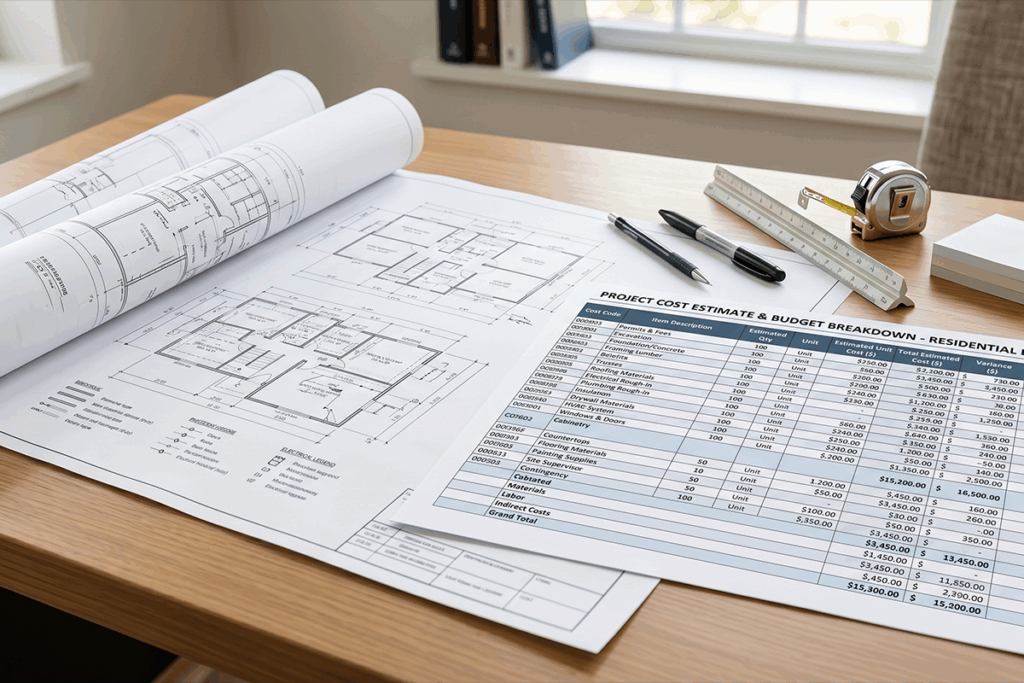
In a cost-plus contract, the homeowner pays the actual costs of construction — materials, labor, subcontractors — plus an agreed-upon fee to the contractor. That fee is typically either a flat amount or a percentage of total costs.
The appeal of cost-plus is transparency. You can see every invoice. You know exactly what materials cost and what the labor rates are. There is no markup hidden inside a lump sum.
The risk is that transparency does not equal predictability. Cost-plus estimates are projections. The actual number is determined by what things cost when you buy them and what conditions reveal themselves during construction. Price movements in materials, unexpected site conditions, and scope changes all flow directly to the homeowner. The contractor’s fee is fixed or percentage-based. Your costs are not.
The homeowner also carries an additional burden in a cost-plus arrangement: oversight. Reviewing invoices, tracking costs against projections, and flagging when spending appears to drift requires time, attention, and some level of construction knowledge. For homeowners who want to stay closely involved in the financial details of their project, that can be a feature. For most, it is an added burden on top of an already demanding process.
The Estimate Problem
The most common point of confusion when comparing these two contract types is the upfront number.
A cost-plus estimate is a projection. It reflects what the contractor expects the project to cost based on current pricing and assumptions about conditions they have not yet encountered. It is not a commitment. The actual number comes later.
A fixed-price proposal is a commitment. The contractor has built their contingency and risk into the number. It will typically look higher than a cost-plus estimate for the same project — because it is a finished number, not a starting point.
Comparing a fixed price to a cost-plus estimate is not an apples-to-apples comparison. A more useful comparison is fixed price versus the actual final cost of a cost-plus project. In most cases, the gap is smaller than expected, and often the fixed-price project comes in lower.

When Cost-Plus Can Make Sense
Cost-plus is not inherently bad. There are scenarios where it is the more practical arrangement.
Projects with genuinely undefined scope are one example. If a homeowner wants to renovate a historic property where the extent of structural issues cannot be known until walls are opened, locking in a fixed price requires the contractor to build in substantial contingency for unknowns. In that case, cost-plus may reflect actual project economics more accurately.
Projects where the homeowner wants to make design decisions progressively — selecting finishes and materials as construction advances rather than specifying everything upfront — are another. A fixed-price contract requires a complete specification before the price is set. If a homeowner is not ready to make those decisions at contract time, cost-plus can accommodate a more open-ended process.
The tradeoff in both cases is predictability. The homeowner gets flexibility and gains it at the cost of certainty.
For Most Nebraska Custom Home Builds, Fixed Price Is the Better Fit
For a homeowner building a custom home or shouse with a defined scope, on a defined lot, with a defined budget, fixed price is almost always the better structure. The scope is knowable. The specifications can be set before construction begins. The risk of cost overruns is real, and a fixed-price contract shifts it to the party best positioned to manage it.
The oversight burden of a cost-plus project is also worth taking seriously. Managing receipts and invoices through an 8 to 10 month construction process is not a casual task. Most homeowners who start a cost-plus project expecting to stay closely involved find the reality more demanding than they anticipated.

Elev8 Construction uses fixed-price contracts for custom home and shouse projects across Central Nebraska. We take the time to develop a complete scope and specification before setting a price because we want the number we give you to mean something. Reach us at elev8308.com or call 308-346-4180.
Frequently Asked Questions
What is a cost-plus construction contract?
A cost-plus contract requires the homeowner to pay the actual costs of construction — materials, labor, and subcontractors — plus a contractor fee. The fee is either a flat amount or a percentage of total costs. The homeowner carries the risk of cost increases and unexpected conditions.
What are the main risks of a cost-plus contract for a homeowner?
The primary risk is budget unpredictability. Material price increases, higher-than-expected subcontractor costs, and unexpected site conditions all flow to the homeowner under a cost-plus arrangement. The contractor’s margin is protected regardless of what the project actually costs.
Why does a fixed-price proposal often look higher than a cost-plus estimate?
A fixed-price proposal is a finished number that includes the contractor’s contingency for risk. A cost-plus estimate is a projection — it is not a commitment and does not include that contingency. Comparing them is not an apples-to-apples exercise. The all-in final cost of a cost-plus project frequently meets or exceeds the fixed-price alternative.
Which contract type is better for a first-time home builder?
Fixed price is almost always the better starting point for a first-time builder. The budget certainty simplifies financing, reduces stress, and allows you to focus on the experience of building rather than tracking costs. First-time builders typically underestimate the oversight burden that a cost-plus arrangement requires.
Can I switch from cost-plus to fixed price mid-project?
In theory, yes, though it requires agreement from both parties and a clear scope at the point of transition. In practice, converting mid-project is complicated and often not worth pursuing. The better approach is to choose the right contract structure before construction begins.